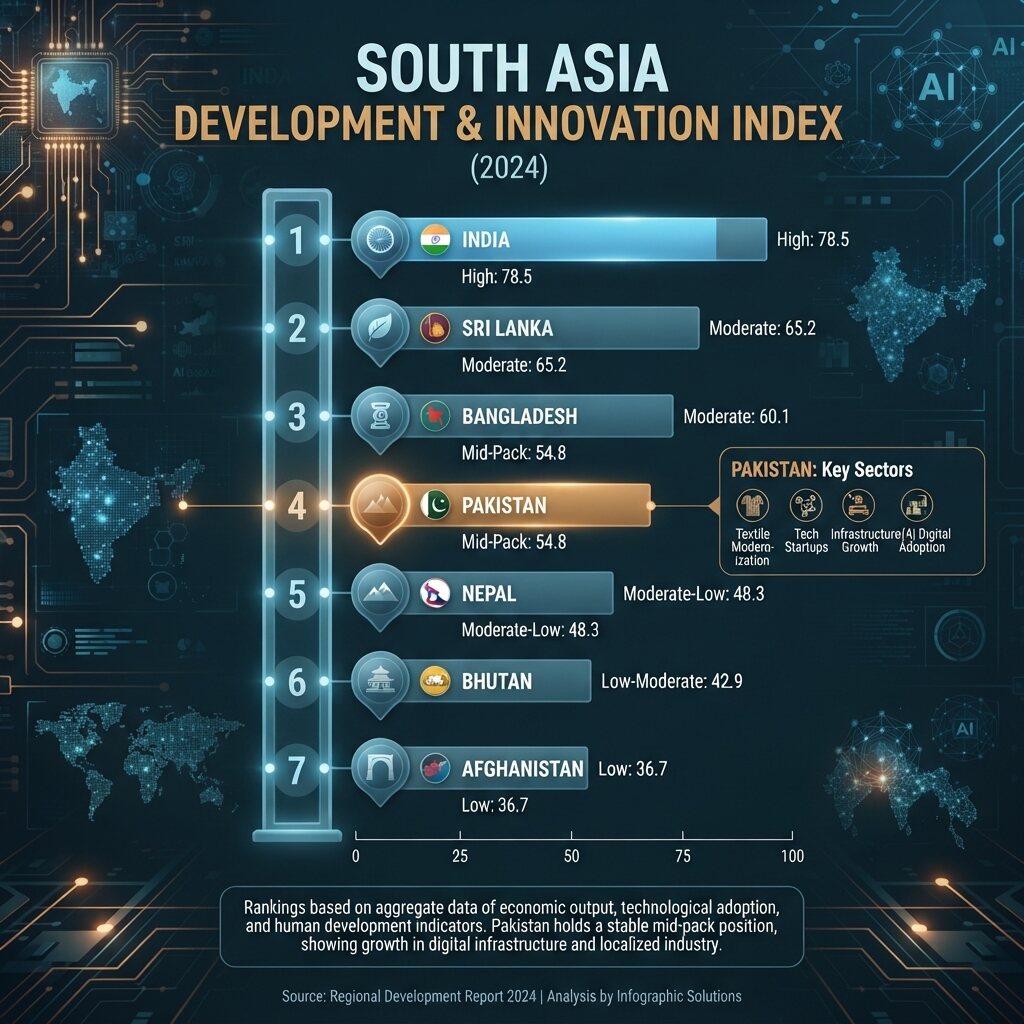
Pakistan ranks 8th out of 17 countries in South and Central Asia on the Oxford Insights Government AI Readiness Index, placing it below India, Bangladesh, and Sri Lanka. The index measures government vision, digital infrastructure, and data systems. Pakistan has made progress but lags due to gaps in infrastructure, data systems, and implementation.
Pakistan has officially entered the 5G era, and on paper, the progress looks impressive: services live in 22 cities, hundreds of active towers, and millions of 5G-ready phones. But if you are a Pakistani user still battling slow internet and dropped calls, you might reasonably ask: where is all this 5G, and why does my connection still struggle?
That is exactly the honest question lawmakers raised this week. This article gives you the real picture, the genuine progress, the frustrating gap between announcement and experience, and what you can actually expect in the months ahead. No hype, just the facts.
Let's start with the real achievements, because they are meaningful. Pakistan currently has 449 active 5G tower sites operating across 22 cities, according to the Pakistan Telecommunication Authority (PTA).
The device side is growing too. The PTA reported that 3.81 million 5G-compatible devices have now been registered across the country. That is a solid base of users ready to use the technology once it reaches them properly.
There is also a bigger capacity story. Pakistan's total available spectrum increased from 274 MHz to 754 MHz following the 5G spectrum auction, which was held in March 2026 and generated around $510 million in government revenue. More spectrum means more network capacity, a genuine foundation for better service.
Encouragingly, local phone manufacturing is scaling up too, with major brands like Samsung, Vivo, Oppo, Infinix, and Tecno now assembling 5G smartphones in Pakistan, which should make devices more affordable over time.
Here is the crucial detail that explains why your internet may not feel any faster. The 5G being offered right now is not built on new, dedicated 5G infrastructure.
The PTA Chairman was refreshingly candid about this. He explained that no new infrastructure had been deployed so far, and that 5G services had been enabled on existing mobile towers and network infrastructure. In technical terms, this is a "non-standalone" rollout, operators are layering initial 5G signals onto their existing 4G towers rather than building fresh 5G networks.
This is why the real-world experience lags the headlines. True 5G speeds and reliability require dedicated infrastructure, which is still coming. For now, many users see little practical difference.
The gap between promise and reality was the main theme when officials briefed Parliament. The National Assembly Standing Committee on IT expressed serious concern over the poor state of internet and mobile services.
Importantly, they noted this is not just a rural problem anymore. Connectivity problems were no longer limited to remote regions and were also affecting major urban centres, including Karachi. Members highlighted slow internet speeds and repeated failures in connecting mobile calls despite multiple attempts, issues that disrupt businesses, online education, and remote work.
One committee member raised a pointed concern about the pace. PTA Member Sadiq Memon warned that if deployment continues at the current rate, nationwide 5G rollout may not be completed until 2035, by which time the technology could already be outdated. That is a sobering caution against complacency.
The country's largest city highlights the uneven rollout. Karachi currently has 50 active 5G sites, while some cities like Hyderabad have only three.
For a metropolis of Karachi's size and economic importance, 50 sites is thin. Recognizing this, the government pushed back. Minister of State for IT Shaza Fatima said Karachi, Pakistan's largest city, deserves greater priority and attention, and the committee urged operators to install more 5G towers there. Matching 5G density to a city's actual size and traffic is now a clear government demand.
Any honest discussion of Pakistan's internet must address a root cause that no amount of spectrum can fix on its own: power. The committee identified electricity shortages as a major challenge affecting service quality.
The logic is simple but serious. Prolonged power outages adversely affect the performance of mobile towers, resulting in poor internet connectivity and disruptions. A tower without reliable power cannot deliver reliable service, no matter how advanced the technology. This means Pakistan's connectivity future is tied not just to telecom investment, but to fixing its wider energy reliability.
Good connectivity is not a luxury, it is the backbone of the digital economy Pakistan is trying to build.
For freelancers and remote workers, reliable high-speed internet is essential income infrastructure. Dropped calls and slow uploads directly cost money and clients. The millions earning foreign exchange online need this to work.
For businesses and startups, especially those in e-commerce, SaaS, and digital services, connectivity quality affects everything from operations to customer experience.
For students, online education depends on stable internet, and gaps deepen inequality between connected and unconnected areas.
For the economy, Pakistan's ambitious digital goals, IT exports, AI, fintech, all rest on solid connectivity. 5G done right could be a genuine accelerant; done poorly or slowly, it becomes a bottleneck.
The realistic takeaway from officials themselves is one of patience. The PTA said new 5G infrastructure would be deployed gradually in subsequent phases, expected to improve internet quality and speed over the next six to eight months.
The full journey is even longer. Pakistan's official plan spreads the nationwide 5G rollout across four phases over about nine years, with operators required to expand coverage and fiber connectivity steadily. So while 5G is technically "here," its real, transformative benefits will arrive gradually, city by city, tower by tower, over years, not overnight.
The honest advice for users: do not expect a dramatic speed jump immediately just because 5G launched. Improvement is coming, but in stages.
The direction is positive but demands execution. If operators deploy dedicated infrastructure on schedule, prioritize dense urban coverage like Karachi, expand fiber, and, crucially, if power reliability improves, Pakistanis should see meaningful gains over the coming years.
The risks are equally clear: slow deployment, the electricity problem, and uneven city coverage could keep the experience frustrating. The next six to eight months, when new infrastructure is promised, will be an important test of whether 5G starts delivering real improvements.
Pakistan's 5G rollout is real progress worth acknowledging, 22 cities, hundreds of towers, millions of ready devices, and vastly more spectrum. But the honest truth, as the country's own lawmakers stressed, is that the technology has not yet translated into better service for most users, largely because it is running on old infrastructure amid ongoing power challenges. The foundation is being laid, and improvements are promised in the months ahead. For now, Pakistani users should welcome the progress but keep expectations realistic. True 5G is coming, just gradually. The real test is turning announcements into the fast, reliable internet Pakistan's people and economy genuinely need.
This article is for general informational purposes only and reflects official briefings and reports available in July 2026. Rollout timelines, coverage, and figures can change; check official PTA and operator updates for the latest in your area.
Pakistan ranks 8th out of 17 countries across South and Central Asia on the Oxford Insights Government AI Readiness Index, placing it below regional neighbors including India, Bangladesh, and Sri Lanka. The index, a credible international benchmark, assesses countries on government vision and policy, digital/technical capacity, and data infrastructure, reflecting the practical foundations needed to turn AI ambitions into reality.The ranking is a reality check against Pakistan's ambitious AI narrative. Fairly, Pakistan has made genuine progress: it approved its first National AI Policy, announced a $1 billion AI investment plan by 2030, launched training programs like AI Seekho, and is building sovereign AI infrastructure. Research has noted Pakistan among countries making progress.However, its foundations lag its ambitions. Key reasons for the ranking: weak digital infrastructure (unreliable electricity and uneven internet quality directly undermine AI readiness), underdeveloped and poorly governed data systems, slow implementation (strong on announcements, weaker on delivery), and a limited pool of advanced AI skills relative to the country's size. Neighbors like India have invested consistently for years in national AI missions, digital public infrastructure, and data systems, building a head start.Why it matters: AI readiness influences investor confidence, economic growth capture, quality of public services, and where global companies choose to build. The ranking effectively serves as a roadmap of what Pakistan must fix.Path forward: match ambition with foundation-building, reliable power and connectivity, organized data governance, expanded AI skills, and consistent execution of existing policies. If delivered well, Pakistan's ranking should improve in future editions.This is informational analysis; rankings and methodologies vary by source and update over time.