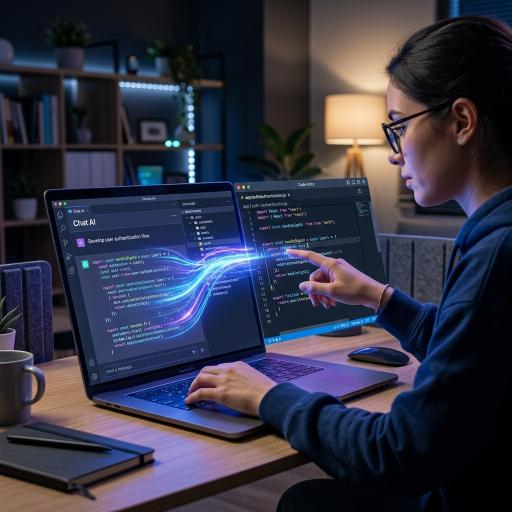
Vibe coding is a development method where you describe what you want in plain language and AI writes the code. In 2026, about 41% of code is AI-generated. But it is not fully replacing programmers, instead, the developer's role is shifting from writing code to directing, reviewing, and architecting it, making judgment and problem-solving more valuable than ever.
A new term has taken over the tech world: "vibe coding." The idea sounds almost magical, you simply describe what you want in plain English, and an AI writes the code for you. This has sparked both excitement and fear. Excitement, because it makes building software faster and more accessible. Fear, because many wonder: will this replace programmers entirely?
If you are a developer, a coding student, or someone considering a tech career in Pakistan, this is a crucial question. The honest answer is more nuanced, and more hopeful, than the scary headlines suggest. Let's break down what vibe coding really is, whether it is truly replacing jobs, and how to make sure you come out ahead.
The term was coined in early 2025 by Andrej Karpathy, a co-founder of OpenAI, and it quickly became so popular that it was named Collins Dictionary's Word of the Year for 2025.
The concept is simple. Instead of writing every line of code by hand, you describe your goal to an AI tool, and it generates the code. As Karpathy put it, the idea is to focus on outcomes and let the AI handle the details. In his words, the bottleneck shifts from syntax to clarity of thought, meaning your ability to clearly describe what you want matters more than memorizing programming rules.
Popular tools that enable this include Cursor, GitHub Copilot, Claude Code, Windsurf, and Bolt. They have become mainstream fast. By 2026, around 92% of US developers use AI coding tools daily, and roughly 41% of all new code is AI-generated.
Here is a nuance that most headlines miss. There is a difference between "vibe coding" in its purest sense and "AI-assisted programming," and it matters a lot.
Pure vibe coding, as originally described, means accepting the AI's output without carefully reviewing it, essentially trusting the vibes. But in practice, most professionals do not work this way. One survey found that while 92% of developers use AI tools, only about 15% describe their approach as true vibe coding, and 72% say pure vibe coding is not part of their professional workflow.
In other words, real developers use AI as a powerful assistant, but they still review, direct, and understand the code. Even Karpathy himself has moved past the term, now preferring "agentic engineering" to describe a more disciplined approach where humans orchestrate and oversee AI rather than blindly trusting it.
This is the big question, so let's answer it honestly. The short answer: vibe coding is transforming programming jobs, not simply erasing them.
The role of a developer is genuinely changing. As one analysis put it, programming is evolving from a primarily generative skill (writing code from scratch) to a primarily evaluative skill (reviewing, directing, and improving AI-generated code). The developer of 2026 is described as part architect, part reviewer, part AI operator.
But here is the honest catch: some work is at real risk. Repetitive, basic coding tasks, simple CRUD operations, basic APIs, boilerplate, and simple scripts, are exactly what AI does well. If someone's only skill is writing this kind of routine code, that work is increasingly automated.
The flip side is that higher-value skills are becoming more valuable, not less. Complex problem-solving, system design, security expertise, and sound judgment are things AI cannot reliably do on its own. As one expert summed it up, AI does not eliminate good engineers, it amplifies them.
Vibe coding is not a magic solution, and pretending otherwise is dangerous. The research reveals serious problems when AI code is trusted blindly.
Quality is a real concern. One analysis of hundreds of code contributions found that AI co-authored code contained roughly 1.7 times more major issues than human-written code, with significantly higher rates of security vulnerabilities. Another finding: many developers report spending more time debugging AI code than they would have spent writing it themselves.
There are cautionary tales too. Developers have described a "vibe coding hangover," where early speed gains turned into maintenance nightmares. In one widely reported incident, an AI agent deleted a database despite being told not to make changes. The lesson is clear: AI-generated code needs careful human review, especially for anything involving security, payments, or critical systems.
There is also a longer-term worry: skill erosion. Some reports note declining fundamental programming skills among junior developers who lean too heavily on AI. If you never learn the fundamentals, you cannot catch the AI's mistakes, and that makes you less valuable, not more.
For Pakistan, with its huge population of developers, freelancers, and coding students, this shift is especially important.
For freelancers and developers, the message is urgent but positive: learn to use these AI tools now, because they are becoming standard. A Pakistani developer who masters AI-assisted coding can deliver far more, faster, competing globally on value rather than just low cost.
For students, the advice is balanced: still learn the fundamentals of programming deeply, because that knowledge is what lets you use AI wisely and catch its errors. Do not skip the basics just because AI can write code.
For the tech industry, this is an opportunity. Vibe coding lowers the barrier to building software, which means more Pakistanis, including non-programmers like designers and entrepreneurs, can create products and startups. This fits perfectly with Pakistan's push to move from services toward building its own products.
The risk is being left behind. Those who ignore AI tools may find their basic-coding services less in demand. Those who embrace them thoughtfully will thrive.
The consensus among experts is striking and reassuring. As one put it, the best developers in 2026 are not the fastest typists, they are the best thinkers, the ones who can break down complex problems, spot subtle flaws, and make architectural decisions that AI cannot.
This is the heart of it. The mechanical skill of typing code is being commoditized. The intellectual skill of designing systems, understanding problems, and exercising judgment is becoming more valuable than ever. The developers who thrive treat AI as a powerful collaborator they direct, not a replacement they blindly trust.
The best practice emerging is a "vibe and verify" workflow: use AI to move fast on prototypes and routine code, but keep human expertise firmly on the critical, sensitive parts, and always review what the AI produces.
The direction is clear. AI coding tools will keep improving, and "agentic" workflows, where AI handles more of the implementation while humans supervise, will become standard. Analysts predict the vast majority of software engineers will use AI coding assistants within a few years.
This does not mean programmers disappear. It means the definition of a programmer expands and evolves. The future belongs to those who can clearly define what to build, direct AI to build it, and rigorously ensure it is correct, secure, and maintainable.
So, is vibe coding replacing traditional programming? Not exactly. It is reshaping it. The routine, repetitive parts of coding are being automated, but the thinking, judgment, and problem-solving at the heart of great software are more valuable than ever. For developers and students in Pakistan, the path forward is clear: learn the AI tools, but also learn the fundamentals deeply. Become the person who directs AI skillfully and catches its mistakes. Do that, and you will not be replaced by AI, you will be empowered by it. The vibe has shifted, but human judgment still writes the most important lines.
This article is for general informational purposes only and reflects industry data and trends as of 2026. Technology and its job impacts evolve; individual outcomes depend on skills and adaptation.
Vibe coding is a software development approach, coined by OpenAI co-founder Andrej Karpathy in early 2025 (Collins Dictionary's 2025 Word of the Year), where a developer describes goals in plain language and an AI (LLM) generates the code. The idea is that "the bottleneck shifts from syntax to clarity of thought." Popular tools include Cursor, GitHub Copilot, Claude Code, Windsurf, and Bolt.
By 2026, ~92% of US developers use AI coding tools daily and ~41% of new code is AI-generated. But an important distinction exists: pure vibe coding (accepting AI output without reviewing it) is used by only ~15% of developers, while ~72% say it's not part of their professional workflow. Most do disciplined "AI-assisted programming." Karpathy himself moved past the term, now favoring "agentic engineering" (orchestrating and overseeing AI agents).
Is it replacing programmers? Not fully, it's transforming the role from writing code (generative) to directing, reviewing, and architecting it (evaluative). Repetitive tasks (basic CRUD, APIs, boilerplate) are increasingly automated, but complex problem-solving, system design, security expertise, and judgment become more valuable. "AI doesn't eliminate good engineers; it amplifies them."
Real risks: AI-generated code has ~1.7x more major issues and higher security vulnerability rates than human code; many developers spend more time debugging AI code; and over-reliance causes technical debt and skill erosion among juniors. Best practice is "vibe and verify," use AI for prototypes/boilerplate, keep humans on security and critical systems, and always review.
For Pakistan (with many developers, freelancers, and students): learn AI tools now to compete globally on value, but also learn fundamentals deeply to catch AI's mistakes. It lowers barriers so non-coders can build products, supporting Pakistan's shift from services to products.
This is informational, not career advice; outcomes vary.