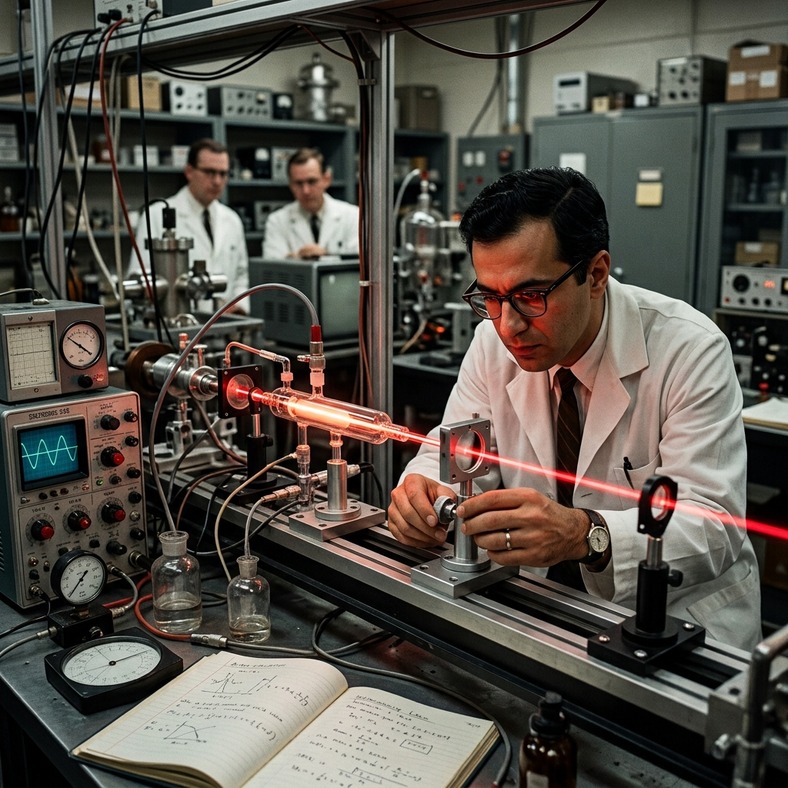
Ali Javan (1926-2016) was an Iranian-American physicist who co-invented the first gas laser, the helium-neon laser, in 1960 at Bell Labs. It was the world's first continuous-beam laser, enabling barcode scanners, fiber-optic internet, laser printers, and medical devices. On December 13, 1960, Javan used it to make the first-ever laser-transmitted phone call.
Every time you swipe a product at a checkout, stream a video, or undergo laser eye surgery, you are using the legacy of one man's invention. Most people have never heard his name. He was Ali Javan, and the world he helped build surrounds us completely, even as history nearly forgot him.
On December 13, 1960, Javan and his colleagues did something no one had ever done: they used a laser beam to transmit a human phone call. It was a quiet moment that would echo through every corner of modern technology. This is the story of the forgotten genius behind it, and why his journey matters so much for young dreamers today.
Ali Javan was an Iranian-American physicist and inventor, born in Tehran in 1926 into a family of Azerbaijani heritage from Tabriz. From childhood, he was drawn to big questions. As he once recalled, he started thinking about mathematics from a very young age.
His path to greatness was anything but conventional. Javan came to the United States in 1949, and what happened next is remarkable. He earned his PhD in physics at Columbia University in 1954 without ever having received a bachelor's or master's degree, studying under the Nobel Prize-winning physicist Charles Townes.
Think about that for a moment. He walked into one of the world's top universities without a diploma and walked out with a doctorate, and a mind that would reshape the century.
Javan's defining work came at Bell Telephone Laboratories. In 1959, he became the first to propose the concept of the gas laser, publishing his idea in a leading physics journal. Many doubted it would work. As he later admitted, even people on his own team had hesitations and doubts.
But he pushed ahead. In 1960, working with colleagues William Bennett Jr. and Donald Herriott, he built a successful prototype, the helium-neon laser. It was a historic first: unlike earlier lasers that produced only quick bursts, Javan's created a continuous beam of light. That single difference is what made the laser truly useful for the modern world.
He described the moment he first saw it work as unforgettable, a beautiful pink glow of light that, in his words, spoke for itself.
Then came the moment that captured the invention's promise. On December 13, 1960, Javan and his Bell Labs colleagues used the laser light beam to place a telephone call, the first time in history that a laser beam had been used to transmit a telephone conversation.
The world did not erupt in applause. There were no headlines celebrating it. But that quiet phone call was a glimpse of the future, a future where light itself would carry our voices, our messages, and eventually the entire internet across the globe.
Javan's helium-neon laser is considered one of the most useful and practical types of laser ever made. Its impact is almost impossible to overstate. Future generations of gas lasers led to inventions in internet data transmission, barcode scanners, metal welding, medical technologies and monitoring, and laser printers.
In other words, his work quietly powers daily life. The scanner at your grocery store. The fiber-optic cables carrying this very article to your screen. The precision tools in modern hospitals. All trace back to that continuous beam of light.
His original 1960 device now holds a place of honor. Javan's original 1960 helium-neon laser device is currently on display at the Smithsonian Institution's National Museum of American History.
He did not stop there. At MIT, he developed the first method for accurately measuring the speed of light and launched the entire field of high-resolution laser spectroscopy, building one of the largest laser research labs in the world.
Javan's genius was recognized by those who knew the science. In 2007, he was ranked 12th on the Daily Telegraph's list of the "Top 100 Living Geniuses." He was inducted into the National Inventors Hall of Fame and received the Albert Einstein World Medal of Science, among many other honors.
And yet, ask most people on the street, and they will not know his name. This is the strange fate of many quiet builders: their inventions become so woven into life that the inventor disappears behind the work. That is exactly why stories like his deserve to be told.
Ali Javan was more than a physicist. While at Columbia, he also studied music, and he saw a deep connection between the two. His words on this are worth sitting with.
"Physics and music, you find the same spirit in both of them," he once wrote. "It just manifests itself in different directions. There's something immensely beautiful about physics, even though it's very difficult."
He believed discovery had an aesthetic soul. He once explained why he worked so tirelessly on hard problems: there is something very beautiful at the end of the line you are looking for, an aesthetic element. It is a reminder that great science, like great art, is driven by wonder.
Here is why we tell this story. A scientist from Tehran, from the Muslim world, without a conventional academic path, ended up at the Smithsonian, shaping every corner of modern digital life. That is a story we do not tell enough.
Ali Javan walked into Columbia University without a diploma and walked out reshaping the 20th century. His journey is proof that brilliance is not confined by geography, wealth, or a perfect résumé. It can come from anywhere, including a modest home far from the world's famous labs.
At Connected Pakistan, we believe the next Ali Javan, the one who rewires how the world communicates, might be sitting in Lahore, Karachi, Quetta, or Gilgit right now, thinking a thought no one around them understands yet. The lesson of Javan's life is simple: your background does not decide your ceiling. Your curiosity does.
The world Javan helped create is still expanding. Lasers now drive quantum computing, advanced manufacturing, next-generation medicine, and the fiber networks carrying the AI revolution. As Pakistan builds its own tech future, in AI, freelancing, and startups, the deeper inspiration is to aim not just to use world-changing technology, but to invent it.
That ambition, to build rather than only consume, is exactly the mindset that turns talented young people into the icons of tomorrow.
Ali Javan's story is one of quiet, world-changing genius, the kind history too often overlooks. From a Tehran classroom to the halls of the Smithsonian, he proved that an unconventional path and a curious mind can reshape how humanity lives and communicates. For every young person in Pakistan with a big idea and no obvious road forward, his life is a beacon. Keep building. Keep asking. The light at the end of the line is worth chasing.
This article is for general informational and educational purposes only. Historical details are drawn from reputable sources including MIT, the Smithsonian Institution, Optica, and the National Inventors Hall of Fame.
Ali Javan (December 26, 1926 - September 12, 2016) was an Iranian-American physicist and inventor, born in Tehran into a family of Azerbaijani heritage. He is best known for co-inventing the first gas laser, the helium-neon (He-Ne) laser, in 1960 at Bell Telephone Laboratories, alongside William R. Bennett Jr. and Donald R. Herriott. He first proposed the gas laser concept in 1959.
The helium-neon laser was the world's first continuous-beam (continuous-wave) laser, a crucial advance over earlier pulsed lasers, which made laser technology practical for real-world use. On December 13, 1960, Javan and his colleagues used the laser to transmit a telephone call, the first time in history a laser beam carried a human conversation.
Javan's path was unconventional: he moved to the US in 1949 and earned his PhD in physics from Columbia University in 1954 under Nobel laureate Charles H. Townes, without having received a bachelor's or master's degree. In 1961-62 he joined MIT, where he built one of the world's largest laser research labs, developed the first accurate method to measure the speed of light, and launched the field of high-resolution laser spectroscopy.
His invention underpins modern life: fiber-optic internet and telecommunications, barcode/UPC scanners, laser printers, holography, metal welding, and numerous medical and monitoring technologies. His original 1960 device is displayed at the Smithsonian's National Museum of American History. Honors include induction into the National Inventors Hall of Fame (2006), the Albert Einstein World Medal of Science (1993), and a 2007 Daily Telegraph ranking as 12th among the "Top 100 Living Geniuses." He also studied music at Columbia and saw a shared "spirit" between physics and music.
For Connected Pakistan's audience, Javan's story is inspirational: a scientist from the Muslim world, on an unconventional path, reshaped 20th-century technology, proof that talent and curiosity, not geography or credentials, determine im