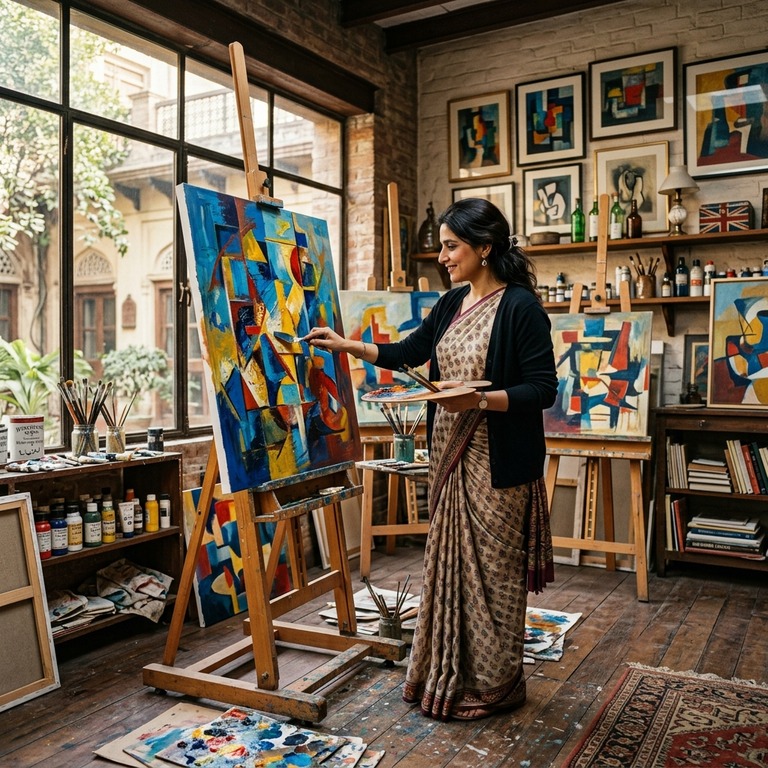
Zubeida Agha (1922-1997) is widely regarded as the mother of Pakistani modern art. After Pakistan's creation in 1947, she was the first artist to hold a modern art exhibition in the new nation. Trained in Lahore, London, and Paris, she introduced modernism and abstraction, and co-founded the country's first contemporary art gallery.
She dreamed of painting, literally. A young woman in Lyallpur (today's Faisalabad) kept having the same recurring dream, night after night, in which she saw herself painting with color. Most people would have dismissed it. Zubeida Agha followed it, all the way to Lahore, then London, then Paris. And when she came home, she reshaped what Pakistani art could even be.
Today she is regarded as the mother of Pakistani modern art, a towering figure whom most Pakistanis have never heard of, yet to whom every Pakistani artist owes a debt. This is her remarkable story: a woman who trusted her vision, mastered the world's greatest art schools, and built the foundations that Pakistani artists still stand on.
Zubeida Agha was born in 1922 in Lyallpur, now Faisalabad, in Punjab. She belonged to the first generation of modern painters in Pakistan, and history remembers her firsts. After the creation of Pakistan in 1947, she was the first artist to hold an exhibition of modern paintings in the new nation, effectively firing the opening shot of modernism in the country.
What makes her path so striking is where it began. She did not start in art at all. She studied Philosophy and Political Science at Lahore's prestigious, women-only Kinnaird College, graduating in the 1940s. Her mind was trained in ideas, logic, and human thought long before it turned to canvas, and that intellectual depth would define her art forever.
Then came the dream. While at Kinnaird, she began to experience a recurring dream about colors, in which day after day she saw herself painting. She did not treat it as a passing fancy. She treated it as a calling.
She was fortunate to come from a progressive family who supported her. At the encouragement of her brother, a prominent art critic, she began formal art lessons with the respected painter B.C. Sanyal in Lahore. But her real awakening came from an unexpected teacher.
She was introduced to Mario Perlingieri, an Italian artist and former prisoner of war interned in Lahore, reputed to have studied under Picasso. Under his guidance, Agha learned a revolutionary idea: to paint an object's essence and idea rather than its literal, objective reality. This was the seed of her modernism.
Agha did not stop at local training. In an era when few Pakistani women traveled abroad for education, she set out to learn from the best in the world. She joined Saint Martin's School of Art in London in 1950 (today part of Central Saint Martins), then moved on to the famed École des Beaux-Arts in Paris in 1951.
Picture that for a moment: a Pakistani woman in the early 1950s, studying at the most prestigious art institutions in Europe, absorbing the modernist currents transforming Western art. She brought that knowledge home, not to imitate the West, but to forge something new for Pakistan.
Zubeida Agha's importance comes from her pioneering role in introducing modernism and abstraction to the newly independent nation. She shifted Pakistani art away from traditional, recognizable, figurative styles toward bold, philosophical explorations of form and color.
The turning point was dramatic. Her first solo exhibition, held in Karachi in 1949, shook the foundations of the Pakistani audience's perception of art. Her ultra-modern, abstract works first baffled critics and viewers, then overwhelmed them. Paintings with titles like Metamorphosis and Wisdom deliberately moved away from literal forms toward color, emotion, and idea. She became known as one of the great colorist painters in Pakistan's history, using intense color not just for beauty but to provoke thought.
Agha's legacy is not only her own art, it is the infrastructure she helped create for everyone who came after. In the early years after independence, she played a pivotal role in establishing formal structures for modern art.
She was instrumental in founding the Society of Contemporary Art, considered the first dedicated art gallery in the country, which became a hub for promoting emerging and established artists across Pakistan. She later served as executive director of the Contemporary Art Gallery in Rawalpindi. In other words, she did not just make great art, she built the very platforms on which Pakistani artists could show their work and grow. This is the mark of a true pioneer: she opened the door and held it open for others.
Agha achieved all of this while navigating a field dominated by men, one that often tried to keep women on the margins. Yet she refused to be boxed in, even by well-meaning labels.
Interestingly, she resisted being called a "woman painter." She insisted she had earned the distinction of being simply "a painter," in a world where professional artists were assumed to be male and women were expected only to teach art. She once reflected that while there might be a certain delicacy in her use of color that owed something to her gender, her identity as an artist stood on its own merit. She summed up a quiet strength with the observation that women may seem more pliable, but are actually less willing to compromise. Unmarried and fiercely devoted, she gave her undivided attention to her art.
Perhaps nothing captures her seriousness better than how she described the act of creation itself. She once said: "I am in agony when I paint. It is a total mental experience. The creative act is not only an emotional activity. It is only when the emotion is seized by the intellect that the painting starts taking an artistic shape."
That is not the voice of a hobbyist. That is the voice of a visionary, someone for whom art was a profound fusion of feeling and thought. Her philosophy training echoes clearly in those words.
Agha's contributions were honored in her lifetime and beyond. She received Pakistan's President's Award for Pride of Performance in 1965. In 2006, Pakistan Post issued a commemorative stamp honoring her among ten great Pakistani painters. Her work is held on permanent display at the National Art Gallery in Islamabad, and in recent years international auction houses and exhibitions have celebrated her as a foundational figure in South Asian modern art.
Often called the grande dame of Pakistani art or a torch-bearer of modernism, her influence runs through generations of Pakistani artists who followed the path she cleared.
At Connected Pakistan, Zubeida Agha's story resonates deeply, because she embodies the spirit of daring to build something that does not yet exist. She did not wait for permission. She followed a dream, literally, trained at the best institutions in the world, came home, and built the very foundations Pakistani artists still rely on today.
That is the energy behind SheCan. It is the spirit of every young woman in Pakistan who imagines something new, a business, a technology, an art form, a movement, and then goes and builds it despite the obstacles. Agha proved, decades ago, that a Pakistani woman could compete with the world and reshape her nation. Your dream is valid. Your field is yours to shape. She proved it first.
Zubeida Agha turned a recurring dream into a revolution. She brought modern art to a young nation, opened institutions that nurtured countless artists, and did it all with uncompromising vision in a world that doubted women. She deserves to be a household name, celebrated not just as a great artist, but as a builder, a pioneer, and an inspiration. Her life is proof that vision, followed with courage, can change a country. Share her name. Every Pakistani, and every dreamer, deserves to know it.
This article is a tribute based on public records and art-historical sources about Zubeida Agha's life and work, intended to honor her legacy and share her story.
Zubeida Agha (1922-1997) is widely regarded as the "mother of Pakistani modern art." Born in Lyallpur (now Faisalabad), she belonged to the first generation of modern Pakistani painters and, after Pakistan's independence in 1947, was the first artist to hold an exhibition of modern paintings in the new nation, effectively launching modernism there.
She initially studied Philosophy and Political Science at Lahore's women-only Kinnaird College. A recurring dream in which she saw herself painting led her to formal art training with B.C. Sanyal, and then with Italian artist Mario Perlingieri (reputedly taught by Picasso), who taught her to paint an object's essence rather than its literal form, the seed of her modernism. She later studied at Saint Martin's School of Art, London (1950) and the École des Beaux-Arts, Paris (1951), remarkable for a Pakistani woman of that era.
Her first solo exhibition, in Karachi in 1949, shocked audiences and critics with its abstraction but marked the birth of Pakistani modernism. Known as a great "colourist," she used intense color and philosophical abstraction, with works like Metamorphosis and Wisdom. Beyond painting, she co-founded the Society of Contemporary Art (considered Pakistan's first art gallery) and directed the Contemporary Art Gallery in Rawalpindi, building institutions that supported future artists.
She navigated a male-dominated field but resisted the label "woman painter," insisting she was simply "a painter." She received the President's Award for Pride of Performance (1965), was honored on a Pakistan Post stamp (2006), and her work is on permanent display at the National Art Gallery, Islamabad. Her famous words: "I am in agony when I paint... It is only when the emotion is seized by the intellect that the painting starts taking an artistic shape."
This is a tribute based on public art-historical records.