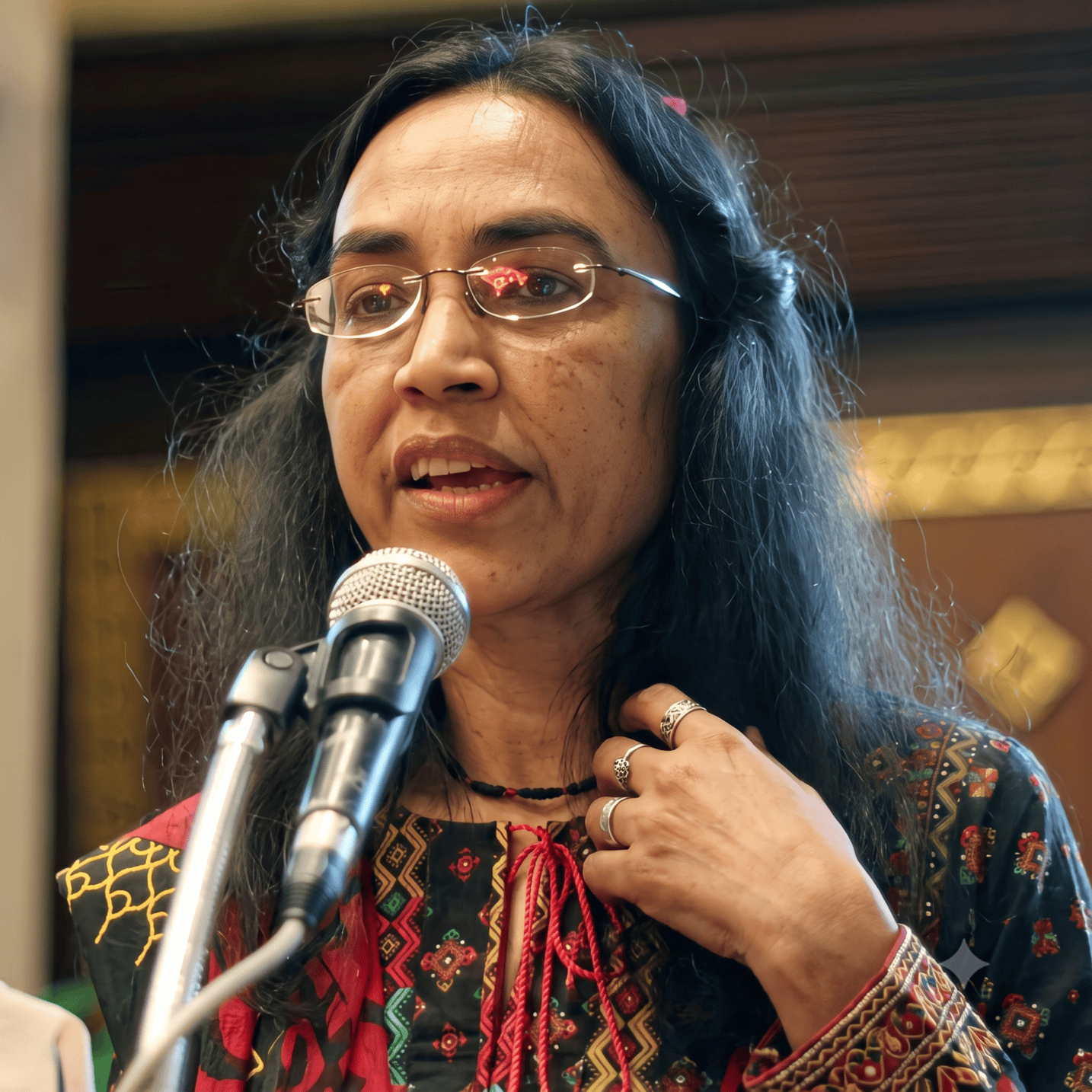
Perween Rahman (1957-2013) was a Pakistani architect and social activist who led the Orangi Pilot Project, helping millions in Karachi's informal settlements build their own sanitation, schools, and housing. An outspoken critic of Karachi's land mafias, she was assassinated on 13 March 2013. Google honored her with a Doodle in 2022.
She won gold medals in architecture school and could have designed grand buildings for Pakistan's wealthy. Instead, Perween Rahman walked into one of Karachi's largest and most difficult informal settlements, and never looked back. For nearly three decades, she gave the city's poorest people something more valuable than charity: the knowledge, tools, and confidence to build their own future.
Her story is one of brilliance, courage, and ultimate sacrifice. She was killed for standing up to powerful interests. Yet her legacy lives on in millions of lives and stands as a lesson in what real, lasting change looks like. This is the story of a true Pakistani hero who deserves to be known.
Perween Rahman's empathy was rooted in her own experience. She was born on 22 January 1957 in Dhaka, then part of Pakistan. After the 1971 war, her family relocated to Karachi as refugees. That personal experience of displacement shaped everything that followed, giving her a deep understanding of what it means to lose your home and have to start again.
She excelled academically. She earned her Bachelor of Architecture from Dawood College of Engineering and Technology, finishing at the top of her class, and went on to earn a postgraduate qualification in housing, building, and urban planning from the Institute of Housing Studies in Rotterdam, the Netherlands.
With those credentials, a comfortable, prestigious career was hers for the taking. She briefly worked at a private architecture firm. But something pulled her toward a different path.
In 1982, Perween Rahman began working, initially as an unpaid intern, with the Orangi Pilot Project (OPP). Founded by the visionary Akhter Hameed Khan, the OPP worked in Orangi Town, one of the largest informal settlements in the world, home to well over a million people who often lacked legal protection for their homes and basic services.
What made the OPP revolutionary was its philosophy. It did not simply hand out solutions. Instead, it helped residents help themselves. Under this model, communities organized and financed their own low-cost sanitation, laying their own sewage lines lane by lane, while the OPP provided technical guidance, training, and maps.
Rahman rose to lead this work. In 1988, she became director of the Orangi Pilot Project's Research and Training Institute (OPP-RTI), managing the housing and sanitation programs and expanding the model's reach and impact.
One of Rahman's most powerful tools was surprisingly simple: documentation. She understood that Karachi's poor were vulnerable because their land and homes were undocumented, making them easy to evict or grab.
So she and her team meticulously mapped the settlements, recording property boundaries, ownership, and the location of natural waterways and goths (villages). This mapping did something profound: it gave communities evidence to defend their rights and exposed how powerful groups were illegally grabbing land and water.
This work made a real, measurable difference. Over the years, the OPP helped establish hundreds of community schools, medical clinics, and thousands of small businesses, while its self-financed sanitation model reached millions. It has been cited as one of the most successful poverty-alleviation and community-development programs in the world.
The genius of Rahman's approach was that it could be replicated. Because it relied on community effort and low-cost methods rather than expensive top-down projects, the OPP model spread far beyond Orangi.
It expanded to hundreds of locations across Punjab, Sindh, Khyber Pakhtunkhwa, and Balochistan, improving the lives of millions of Pakistanis. Its success drew international recognition from institutions like the World Bank and the Asian Development Bank, and NGOs across South Asia, Southeast Asia, and Central Asia adopted similar approaches.
She also founded the Urban Resource Centre in Karachi and supported low-income housing through other organizations, widening her impact even further. And notably, her work brought together people from ethnically diverse and sometimes tense communities, quietly reducing communal friction through shared purpose.
Rahman's mapping and advocacy made her powerful enemies. By documenting land and water, she directly challenged Karachi's land mafias and those who profited from grabbing public resources. She had been an outspoken critic of these groups and their political patrons, and she had received death threats.
On 13 March 2013, as she left her office in Orangi Town, four gunmen opened fire on her vehicle. She was killed, ending a 28-year career devoted to the rights of Pakistan's poor. Her death was mourned across the country and beyond.
Justice was pursued. She was posthumously awarded the Sitara-e-Shujaat, Pakistan's high award for bravery, and years later an Anti-Terrorism Court sentenced those responsible to life imprisonment. But the loss to Pakistan was immeasurable.
Amid all her technical achievements, her sister captured the essence of what Perween Rahman gave people. She said Perween's greatest gift was giving poor communities the confidence to realize that they knew what was best for themselves.
That is the heart of her legacy. She did not treat the poor as helpless recipients of aid. She treated them as capable people who, with the right knowledge and support, could solve their own problems. She trained them, mapped their land, and trusted them to build their own future.
Though she was media-shy and quietly determined, the world did not forget her. In 2022, Google celebrated what would have been her 65th birthday with a dedicated Doodle, describing how her efforts helped define how Pakistani settlements are developed today. The Doodle showed her looking out over the community she loved, surrounded by the maps and tools of her life's work.
It was a fitting tribute to a woman whose impact reached millions but who never sought the spotlight for herself.
At Connected Pakistan, Perween Rahman's story resonates deeply, because it proves that the most powerful technology is knowledge in the hands of the community. She did not parachute in with ready-made solutions. She trained people, mapped their reality, and trusted them to build their own future.
That is exactly the spirit we try to carry forward. The tools change, from sewing sewage lines to writing software, but the mission does not: put knowledge and capability directly into the hands of ordinary people, and trust them to transform their own lives. Whether it is a freelancer learning a global skill or a community mapping its own streets, the principle is the same. Empowerment lasts. Charity fades.
Perween Rahman gave up comfort for purpose, and ultimately her life for justice. She showed that real change does not come from doing things for people, but from enabling people to do things for themselves. Millions live better lives because of her quiet, determined work, and her model continues to inspire community development around the world. Her name deserves to be spoken with pride and remembered with gratitude. Share her story. She earned her place among Pakistan's greatest heroes.
This article is a tribute based on public records and reporting about Perween Rahman's life and work. It is intended to honor her legacy and inform readers about her contributions to Pakistan.
Perween Rahman (22 January 1957 – 13 March 2013) was a Pakistani architect, urban planner, and social activist, and one of the country's most respected community-development figures. Born in Dhaka, she relocated to Karachi as a refugee after the 1971 war, an experience of displacement that shaped her lifelong advocacy for housing rights.
She graduated top of her class in architecture from Dawood College of Engineering and Technology and earned a postgraduate qualification in housing and urban planning from the Institute of Housing Studies in Rotterdam, Netherlands. Rather than a lucrative private career, she joined the Orangi Pilot Project (OPP) in 1982 and became director of its Research and Training Institute in 1988.
The OPP, based in Karachi's Orangi Town (one of the world's largest informal settlements), pioneered community-led development: residents self-financed low-cost sanitation, schools, and housing while the OPP provided technical guidance, training, and mapping. Rahman's documentation of land and water rights helped communities resist eviction and land grabbing. The model reached millions, expanded to hundreds of locations across all four provinces, was replicated across Asia, and earned recognition from the World Bank and Asian Development Bank.
Her opposition to Karachi's land mafias made her a target. Despite death threats, she continued. On 13 March 2013, four gunmen assassinated her near her Orangi office, ending a 28-year career. She was posthumously awarded the Sitara-e-Shujaat, and an Anti-Terrorism Court later sentenced those responsible to life imprisonment. In 2022, Google honored her with a Doodle on her 65th birthday.